
In this article
Your best results matter more than your event count
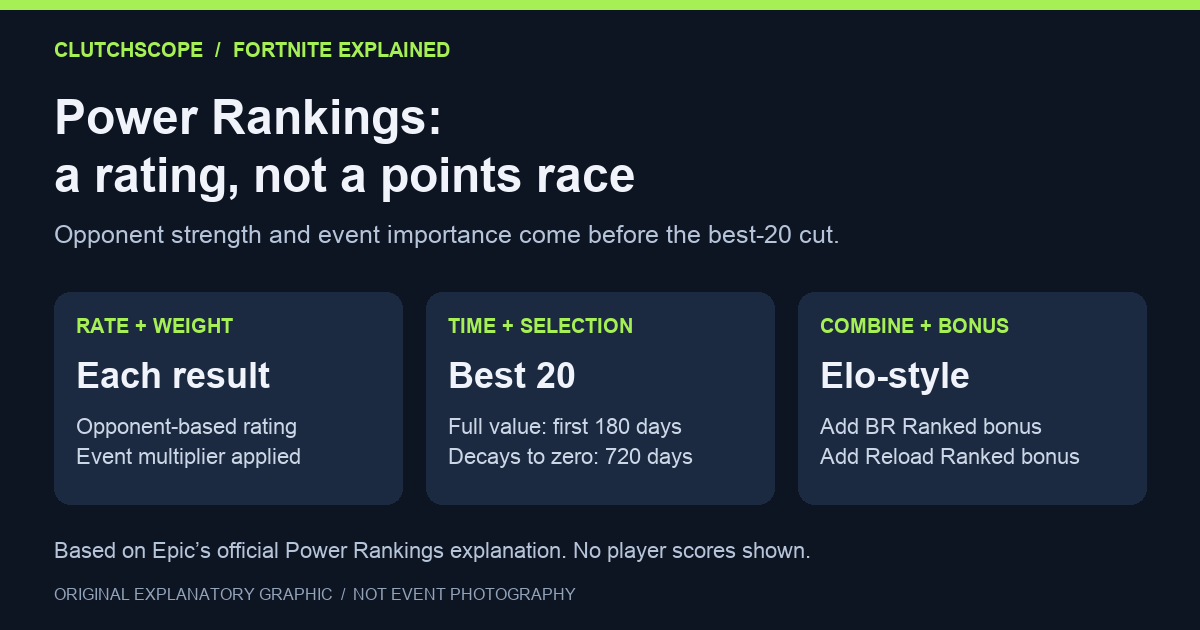
Fortnite’s official Power Rankings are an Elo-style rating, not a running total of tournament points. Epic rates a performance against the opponents in that event, applies an event weight and time decay, then keeps the player’s best 20 performances. Those results are combined Elo-style, with a separate Ranked bonus added afterwards.
That distinction matters if you are trying to improve your position before November’s FNCS Solos Reload. Entering another cup creates an opportunity to improve your rating; it does not guarantee an increase simply because you played more matches.
Why the same finish can mean different things
A placement is only part of the calculation. Beating a stronger field produces a different raw performance rating from beating a weaker one. Epic describes the underlying calculation as multiplayer Elo, weighing a player against each opponent and their rating.
Event importance then changes that raw rating. In Epic’s published explanation, Ranked and Shop Cups carry a 0.8 multiplier, Cash Cups and Victory Cups 1.0, FNCS Heats 1.2, FNCS Major Finals 1.4, and Global Champs 1.6.
These are multipliers applied to a performance rating, not fixed points awarded for entering. A fifth-place finish in one event therefore cannot be compared with fifth in another without considering the field and event weight.
What the best-20 limit actually does
Only the top 20 performances count. A new result replaces one of those if its rating is higher; results below the cut do not affect PR. Epic explicitly says players cannot lose PR by playing.
That does not mean the number can never fall. Results retain their full value for the first 180 days, then decay until they reach zero at 720 days. An older result losing value can reduce a rating even if the player has not just had a bad tournament.
The practical distinction is between an event result failing to improve your best 20 and time reducing the value of results already in that set. Neither is the same as having tournament prize money taken away.
Ranked adds a separate bonus
Epic adds bonuses from both Battle Royale Ranked and Reload Ranked. Its table ranges from zero at Bronze 1 to 1,000 at Unreal for each. This is a Ranked contribution to PR, not a cash reward or an extra tournament placement.
Use the official leaderboard to check your position. It is labelled as updated weekly and supports player search and pinning up to eight players for comparison. Do not assume a just-finished session has already appeared.
PR position is not career earnings
Our Fortnite career-prize board answers a different question: how much tournament prize money players have earned in Fortnite. It is not Epic’s PR table, a current-form ranking or a measure of salary.
When a competition uses PR for entry or a round skip, read that event’s own rules rather than importing a threshold from another tournament. For the upcoming November Solo Reload competition, our qualification guide covers the specific routes; the calendar keeps the regional date window separate from individual start times.