
In this article
November brings a separate solo contest
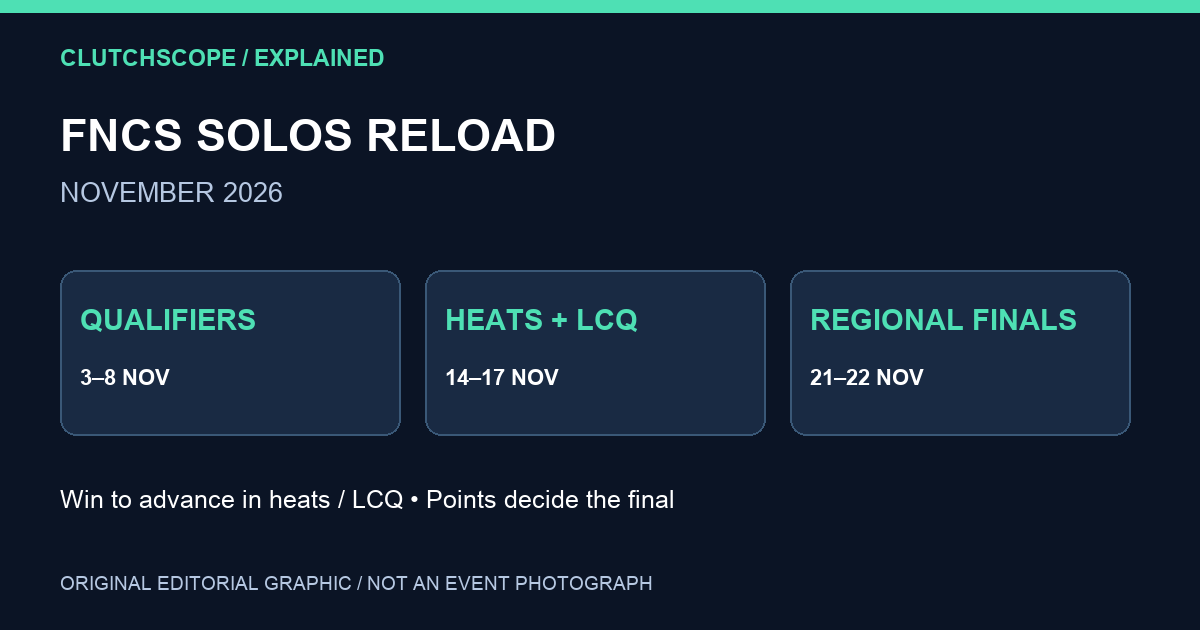
FNCS Solos Reload begins on 3 November 2026, with regional finals on 21–22 November, according to Epic’s rules published on 19 October. The upcoming online competition uses Solo Reload settings. It is separate from both September’s completed duos Global Championship and the Mobile Series championship in Copenhagen this weekend.
The important distinction is what a win earns you. In the heats and Last Chance Qualifier final, a Victory Royale sends a player directly into the regional final. In the final itself, the title is decided by the points leaderboard—not by an instant championship-winning Victory Royale.
The route through November
Epic lists these dates, with final session times displayed in-game:
- 3–4 November: qualifier round one, with the two days’ points combined.
- 7 November: round two; the top 500 in each region advance.
- 8 November: round three; the top 80 advance to heats.
- 14–15 November: heats.
- 16–17 November: Last Chance Qualifier round one, then its final.
- 21 November: finals for Oceania, Middle East and North America Central.
- 22 November: finals for Asia, Brazil, Europe and North America West.
These are regional competition dates, not one worldwide start time. Check your region in Fortnite before planning a session; the rules do not supply a single hour to convert to UTC. Our calendar entry keeps the date window together.
A win advances you—but consistency still has a route
Each heat allows up to eight matches. A match winner immediately qualifies and stops playing that heat; the remaining top seven non-winning players on its points leaderboard also advance. The next ten players from each heat go to the LCQ final.
The LCQ final adds the top 20 from LCQ round one. Across up to five matches, each winner qualifies and leaves the session, then the remaining top five non-winners advance on points. That gives viewers two races to track: who can win the next match, and who is building a strong enough total without a win.
The regional final allows up to ten matches. Its scoring awards 60 placement points for first, 54 for second and five per elimination. Unlike qualifier rounds and LCQ round one, the final has no ten-elimination scoring cap. A player who qualifies with one spectacular win still needs a full final performance.
The entry decision that matters
Round one requires a top-200,000 position on the overall Power Rankings leaderboard, alongside the other eligibility rules. Top-1,000 players may skip directly to round two. But if they choose to play round one, they forfeit that automatic advancement and must qualify through it.
LCQ round one is not a fresh open-entry route: the rules require participation in a qualifier round-one session and no existing advancement to the LCQ final or regional final. Read the full eligibility and region-lock rules before entering.
For the different match-point system used this weekend, see our Mobile Series guide. Follow the Fortnite hub for the separate competitions.