In this article
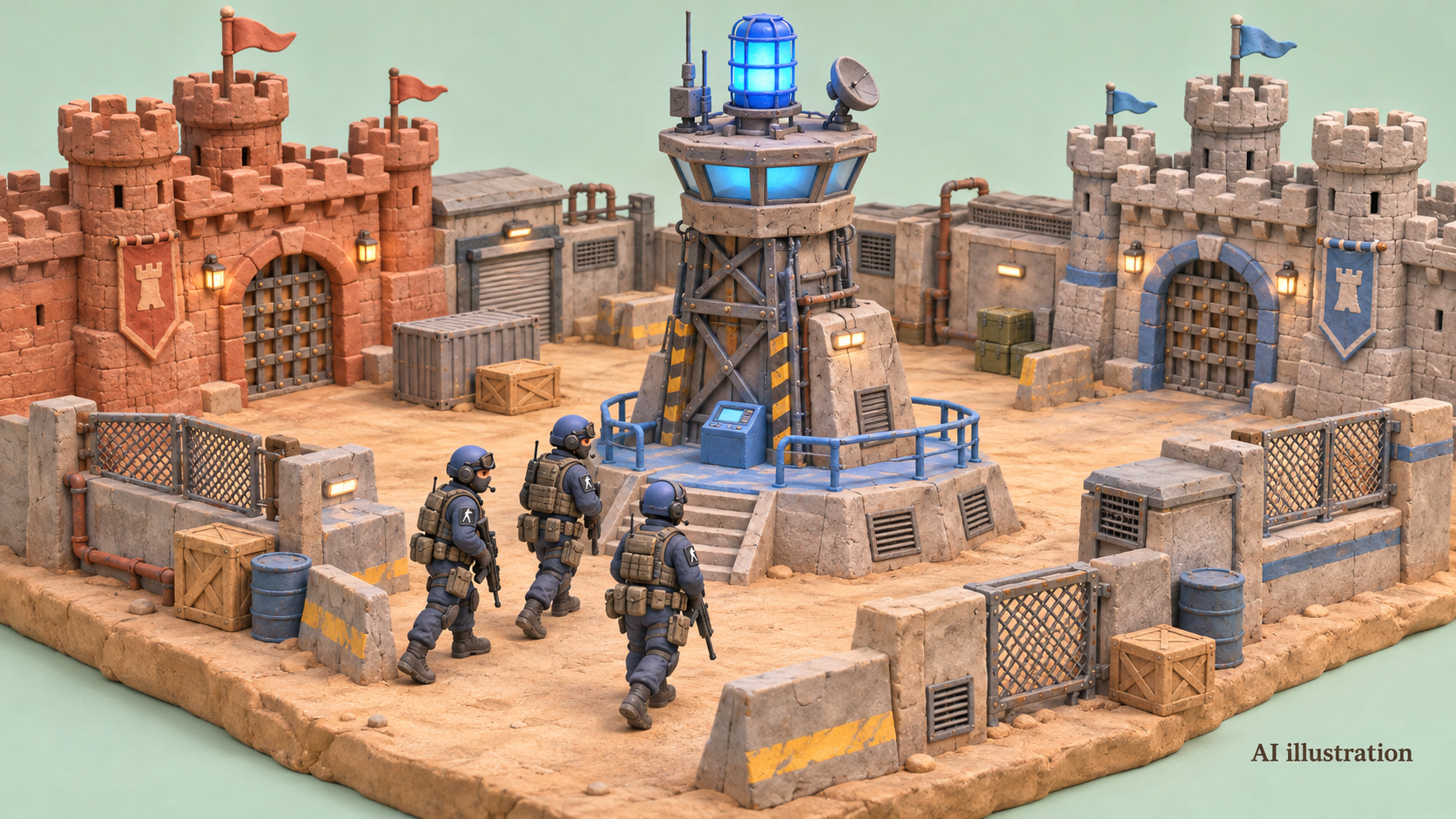
CS2’s Rush mode is a three-player-team contest over a moving sequence of battle arenas: control the tower to win a round, then push through to capture the enemy castle and win the match. It is a separate queued mode, introduced in Valve’s September 23, 2026 update.
That makes its objective different from simply collecting eliminations. Valve’s rule is to control the tower when the enemy team is eliminated or when time expires. Clearing opponents and holding the objective belong to the same round-winning condition.
The round objective and the match objective are different
Within an arena, the tower is the immediate contest. Valve describes limited time and a limited budget, so the team has to clear that objective with the resources available rather than treat each encounter as an open-ended fight.
Winning a round is progress through the gauntlet, not the end of the match. The match-winning target is the enemy castle. Keeping those two scales separate makes the mode easier to follow: the tower decides the local fight; capturing the castle completes the push.
The arenas change between matches
Rush uses randomly selected battle arenas. A familiar encounter in one match does not establish a fixed route for the next. The changing sequence is part of Valve’s intended push-and-pull through the mode.
Rush also has a friends leaderboard that tracks wins. It gives a group a way to compare results without confusing Rush wins with progress in Premier.
Rush is not Premier’s new map-pick system
The same September update changed Premier, which can make the two announcements easy to mix up. In Premier, teams pick two maps each; the game then randomly selects one of those four picks for the match. That replaced the earlier process of banning down to one map.
Rush’s randomisation instead concerns its sequence of battle arenas. The Premier four-map vote is not the rule for choosing a Rush route.